
Snoopy & The Great Mystery Club - Review
- ScorpioOfShadows

- Apr 23
- 17 min read
Snoopy & The Great Mystery Club - A Cozy, Nostalgic Journey Back to the Neighborhood
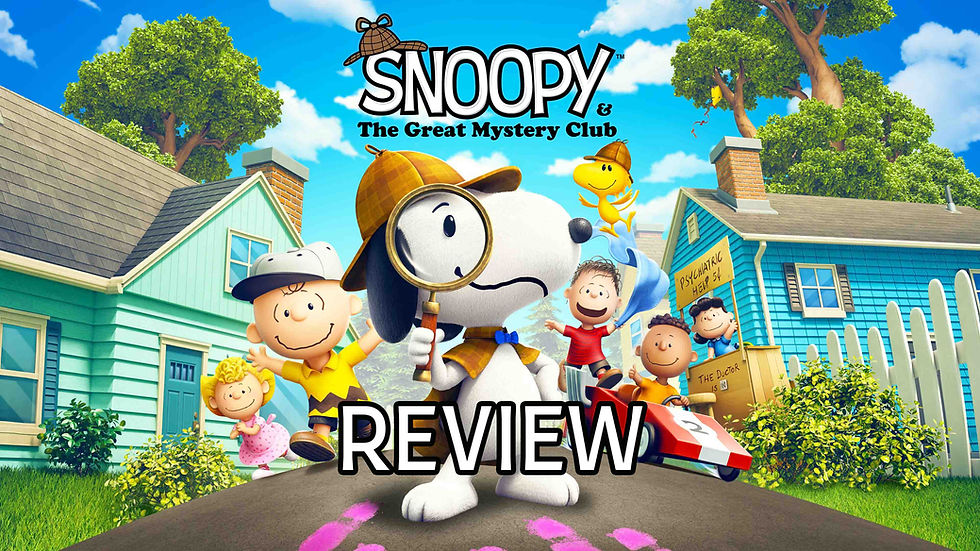
Growing up, there was a specific kind of magic reserved for Sunday mornings. It was the rustle of the weekend newspaper, the vibrant splash of colored ink on the comics page, and the comforting, familiar faces of Charles M. Schulz’s Peanuts gang. For over seven decades, Charlie Brown, Snoopy, and the rest of the neighborhood have served as a cultural touchstone, perfectly balancing childlike innocence with profound, often melancholic, philosophical observations. Transitioning that delicate balance into the realm of video games has always been a daunting task. The interactive medium demands action and momentum, whereas Peanuts thrives on quiet moments, missed baseballs, and existential sighs while leaning on a brick wall. So, when I received a review key for the newly released Snoopy & The Great Mystery Club, my excitement was naturally tempered with a healthy dose of journalistic curiosity.Developed by the talented team at Cradle Games and published by GameMill Entertainment, Snoopy & The Great Mystery Club launched on October 10, 2025, marking the first brand-new Peanuts-themed video game in more than a decade. It promises a family-friendly, feel-good action-puzzle adventure that reunites us with the beloved cast. Settling into my living room and booting up the game on my high-end, current-generation home console—enjoying the absolute pinnacle of visual fidelity, seamless loading times, and a comfortable controller in hand—I prepared to dive into a world of childhood nostalgia. What I found over the course of my playthrough was a remarkably charming, deeply respectful homage to the source material that, while playing it safe mechanically, delivers exactly the kind of warm, fuzzy experience that fans of the franchise are yearning for.In this comprehensive review, I want to break down exactly how Cradle Games managed to capture lightning in a bottle, the clever ways they integrated Snoopy’s boundless imagination into the gameplay loop, and why this title might just be the perfect palate cleanser for gamers looking to unwind, as well as an incredible entry point for younger players.
The Setup: A Deerstalker Hat and a Dream
The overarching premise of Snoopy & The Great Mystery Club is delightfully low-stakes, which is entirely by design. In an era of gaming dominated by world-ending cataclysms and sprawling, morally ambiguous epics, it is incredibly refreshing to play a game where the most pressing issue is a misplaced baseball glove or a lost piece of homework. The narrative is grounded purely in the everyday struggles and triumphs of childhood, wrapped in a blanket of friendship and cooperation.
The game casts me in the role of Snoopy, the world’s most imaginative beagle. Deciding that the neighborhood needs a dedicated sleuth, Snoopy dons a classic Sherlock Holmes-inspired detective outfit and establishes the Great Mystery Club. The core objective of the game is to wander through a micro-open world representing the Peanuts neighborhood, gathering the iconic characters into your club, and helping them solve a series of quaint, localized mysteries.
From a narrative standpoint, Cradle Games deserves immense praise for understanding the assignment. The story isn't trying to be more intricate than the comic strips it is based on; it is surface-level, laid-back, and purely joyful. The script is peppered with the kind of lighthearted, witty dialogue that fans expect. There are no real hardships here, no fail states that punish you, and absolutely no stress. It is a "feel-good" game in the truest sense of the phrase, and I found myself smiling constantly as I trotted Snoopy down the familiar suburban sidewalks.
Chapter by Chapter: A Tour of the Neighborhood
The campaign is structured somewhat like a classic television special, divided into a prologue and four distinct, episodic chapters. This structure is brilliant because it allows the game to introduce mechanics gradually while giving different members of the ensemble cast their moment in the spotlight. I want to take you through my experience of these chapters, as they perfectly illustrate the game’s pacing and design philosophy.
The Prologue: The Mystery Club is Born
My adventure began right in Charlie Brown’s backyard. The introductory chapter, appropriately titled "The Mystery Club Is Born," serves as a gentle, frictionless tutorial. The game took the time to teach me the basic mechanics of movement, interacting with objects, and reading the environment.
My very first objective was to head over to Peppermint Patty’s garden. The game immediately showcased its understanding of character dynamics by having Peppermint Patty force "Chuck" into a baseball pitching sequence. It’s a classic Peanuts setup. I had to help Charlie Brown throw a few baseballs, after which Peppermint Patty—impressed by the initiative—officially joined the Mystery Club. She brings the "Amazing Athlete" dynamic to the team. This opening segment is breezy and inviting, setting a wonderful tone. It establishes that the core rhythm of the game will involve moving from point A to point B, engaging in light, character-specific banter, and completing simple tasks to build up the roster.
Chapter 1: The Detectives Are In
With the club officially formed, the game opened up its boundaries slightly in Chapter 1, "The Detectives Are In". This chapter pushed me away from the residential backyards and toward the local school grounds. The mysteries here felt like a classic day in the life of a grade-schooler, involving tracking down everyday items: a pair of shoes, a mysterious box with a question mark, and a cryptic note.
The narrative hook of this chapter required me to recruit Marcie, the "Spectacular Scholar," because I needed her specific expertise to concoct a special glue to fix an item. Here, I was introduced to the game's penchant for multi-stage fetch quests. I couldn't just ask Marcie for the glue; I had to earn it. I was sent to the school library to find a specific reference book, then to the cafeteria to gather the necessary ingredients, and finally to the science lab to assemble the equipment. After completing a fun little mini-game to mix the glue, Marcie joined my squad.
While a more cynical gamer might roll their eyes at a fetch quest, I found the execution here incredibly endearing. Because the environments are so wonderfully rendered and the dialogue is so sharply written, running these errands feels less like a chore and more like a guided tour of a world I’ve loved since childhood. It’s a scenic route through nostalgia.
Chapter 2: Gone With The Wind
If there is one antagonist in the Peanuts universe more formidable than the Red Baron, it is the Kite-Eating Tree. Chapter 2, "Gone With The Wind," leans heavily into this legendary rivalry. This chapter was a personal favorite of mine because it highlights Charlie Brown’s perpetual, tragicomic bad luck.
The core mystery involved piecing together the scattered remnants of a disastrous kite-flying attempt. I had to scour the neighborhood to recover the kite frame, an umbrella, some string, and the kite tail. The writing in this chapter is particularly strong, filled with the self-deprecating humor that defines Charlie Brown. Every time I found a piece of the kite, the accompanying dialogue brought a smile to my face. This chapter reinforced the thematic heart of the game: perseverance. No matter how many times the kite gets destroyed, or how many times the football is pulled away, the gang keeps trying, and the Mystery Club is there to help pick up the pieces.
Chapter 3: The Phantom of the Concert Hall
By the time I reached Chapter 3, "The Phantom of the Concert Hall," the game introduced a slightly spooky, quasi-supernatural element to the proceedings. The plot revolves around strange noises and occurrences near the concert hall, focusing heavily on Schroeder, the resident Beethoven prodigy. The clues I had to track down included a speaker, a piece of cheese, a piano, and a music sheet.
I have to be completely honest here: this chapter is where the game’s quest design becomes noticeably convoluted. To get Schroeder to help with the investigation, I needed him to join the club. But Schroeder wouldn't join until I fixed his piano. Fixing the piano triggered what I can only describe as an epic chain of errands. I had to ask Franklin for wood, but Franklin needed wood from the forest first. Then, I had to dig through a garage to find five specific piano strings. After that, I needed more glue, which meant finding Marcie, who informed me that the specific glue Schroeder needed had been lent to Pig-Pen.
I must admit, by the time I finally retrieved the glue from Pig-Pen, I had momentarily forgotten that I was supposed to be investigating a phantom. The pacing here drags slightly, and the reliance on chaining fetch quests together becomes highly transparent. However, looking at it through the lens of the developer's intent, this protracted sequence ensures that the player interacts with almost every member of the cast, exploring every nook and cranny of the map. It’s a bit of padding, certainly, but it’s padding filled with charming character interactions, so I found it easy to forgive. It is a fantastic way to keep younger players engaged with simple, clear objectives without overwhelming them with complex puzzle logic.
Chapter 4: The Lake Ness Monster
The game completely redeems any pacing issues from the third chapter when it transitions into its finale, Chapter 4: "The Lake Ness Monster". For the final act, the Mystery Club leaves the familiar streets of the neighborhood and travels to a summer camp to investigate rumors of a terrifying beast residing in the local lake.
From a design perspective, this is the strongest section of the game. The summer camp is a bespoke, smaller map, which provides a massive breath of fresh air. After spending hours running back and forth across the sprawling neighborhood, having a dense, focused area to explore felt fantastic. The clues I gathered here—floating debris, a branch with strange bite marks, and a partially destroyed dam—were organically integrated into the environment.
The narrative payoff is incredibly sweet. As I pieced the clues together, the game revealed that the "monster" was nothing more than a family of beavers building a dam. The resolution leads into a beautiful campfire scene where the gang gathers around, plays music, and tells stories about the case. Marcie’s pragmatic explanation of beaver habits mixed with the group's slight disappointment that they didn't find a real ghost or monster is quintessential Peanuts writing. It wraps up the narrative on an incredibly high note, leaving me feeling warm and entirely satisfied with the journey.
The Micro-Open World and the Thrill of Exploration
The setting of Snoopy & The Great Mystery Club is described as a "micro open world". Instead of a linear level-by-level structure, the game gives you free rein to explore Charlie Brown's neighborhood, the school, the baseball field, and the nearby woods. Translating a comic strip that normally exists in fragmented, 2D panels into a cohesive 3D spatial map is a massive undertaking, and Cradle Games did a commendable job mapping out the geography of the Peanuts universe.
Wandering around the town feels surprisingly relaxing. However, I did notice that the world can occasionally feel a bit vast and empty. There are highly detailed, iconic locations—like the brick wall the characters lean on, or Snoopy's doghouse—but they are separated by long stretches of pavement and grass where not much happens. Because the core gameplay involves a lot of back-and-forth fetch quests, you will be doing a significant amount of running. The developers thankfully included a fast-travel system via bus stops scattered around the map, which mitigates the travel time, but the world itself could have benefited from a bit more density.
I also found myself wishing for a bit more incidental interactivity. During the prologue, when I examined objects that weren't tied to a quest—like Woodstock's tiny "office" or Charlie Brown's favorite spot—the game provided charming "flavor text" and unique animations. Unfortunately, this level of detail tapers off. Later in the game, interacting with random objects often just yields a generic, slightly sad comment from Charlie Brown, unless it hides a collectible. It’s a minor missed opportunity for deeper environmental storytelling, but it doesn't detract significantly from the overall joy of inhabiting the space.
Master of Disguise: The Costume Mechanics
If the open world is the canvas, Snoopy’s costumes are the brushes. The most engaging mechanical layer of Snoopy & The Great Mystery Club is the costume system. Snoopy is famous for his active imagination and his myriad alter egos, and the developers smartly weaponized this lore to create a "Metroidvania-lite" progression system. Throughout the game, I unlocked various outfits, each granting Snoopy a unique ability necessary to solve environmental puzzles or access new areas.
Let’s break down the wardrobe:
The Detective: This is your bread-and-butter outfit, the default look for the Mystery Club. Putting on the deerstalker hat gives Snoopy what I can only describe as "Witcher-like senses". With a press of a button, the screen filters, and Snoopy can follow scent trails, highlight hidden footprints, and spot clues that are otherwise invisible to the naked eye. It’s an intuitive, highly effective way to guide the player toward their next objective without relying entirely on a mini-map marker.
The Pirate: Easily my favorite outfit to equip. The Pirate costume allows Snoopy to wield a shovel. As I explored the neighborhood, I frequently came across suspicious mounds of loose dirt. Switching to the Pirate outfit allowed me to dig up these spots, uncovering buried treasure—which in this game usually means hidden collectibles, currency, or crucial quest items. There is a distinct tactile satisfaction to spotting a dirt mound, swapping costumes, and unearthing a prize.
The Gardener / Janitor: This outfit equips our intrepid beagle with a heavy-duty leafblower. Mechanically, it is used to clear obstacles. During autumn in the neighborhood, massive piles of leaves block certain pathways or hide items. Firing up the leafblower scatters them beautifully. Later, when exploring the school, the leafblower doubles as a janitorial tool to dry up massive water puddles blocking the hallways. In fact, dedicating time to drying all the spots in the school unlocked the highly satisfying "Janitor's Helper" achievement for me.
The Beagle Scout: Channeling the spirit of the great outdoors, the Beagle Scout outfit comes into play primarily during the forest excursions and the final Summer Camp chapter. It allows Snoopy to interact with wilderness obstacles and track specific nature-based clues.
This costume system is the mechanical glue that holds the game together. It encourages backtracking in the best possible way. Whenever I gained a new outfit, my immediate instinct was to return to earlier areas of the map to see what new secrets I could uncover. It provides a steady drip-feed of progression that keeps the gameplay loop feeling fresh, preventing the simple exploration from growing stale.
Building the Roster: Character Skills and Dynamics
Snoopy & The Great Mystery Club wouldn't be much of a club if you were doing it alone. The game allows you to build a team of four, swapping characters in and out as the situation demands. The roster includes heavy hitters like Charlie Brown, Peppermint Patty, Marcie, Lucy, Schroeder, Franklin, Pig-Pen, and Sally.
What I absolutely adored about this system is how it alters the flavor of the game. Each character has a designated "skill" or narrative purpose. As mentioned earlier, Marcie is the "Spectacular Scholar," essential for science puzzles, while Lucy is the "Perceptive Psychiatrist". But beyond the mechanical requirements of the story quests, having different characters follow Snoopy changes the contextual dialogue.
When Charlie Brown is in the party, his dialogue is laden with anxiety and doubt, providing an emotional anchor to the silliness. Swap in Lucy, and the banter suddenly becomes sharp, bossy, and hilariously critical. Having Sally in the group even ties into the achievement system; solving a mystery on the first try with her in the party earns the "Lucky Guess!?" trophy. This dynamic party system does a phenomenal job of capturing the diverse personalities of the comic strip. It genuinely feels like you are hanging out with childhood friends, and the underlying message about teamwork and embracing everyone's unique traits is delivered with wonderful subtlety.
Breaking the Monotony: A Wealth of Mini-Games
If the game consisted solely of running from waypoint to waypoint using the detective vision, it would likely wear thin, even given its short runtime. Thankfully, Cradle Games recognized this and injected a fantastic variety of mini-games into the experience to break up the pacing. These activities range from quick-time events to more involved arcade-style challenges.
The Red Baron Dogfights: Snoopy’s imagination isn't limited to detective work. At certain points, the game transitions into exhilarating flying sequences where Snoopy takes to the skies in his Sopwith Camel (his red doghouse) to battle his arch-nemesis, the Red Baron. These segments are a massive departure from the grounded exploration. I had to pilot the "plane" through aerial gates while dodging obstacles. Visually and mechanically, these are absolute highlights, providing a burst of adrenaline to the cozy campaign.
Franklin’s Soapbox Derbies: Taking advantage of the neighborhood’s hilly terrain, Franklin hosts soapbox car races. These are fast-paced, reflex-heavy driving challenges. I had to steer carefully to maintain speed while avoiding hazards on the road. I will note that, initially, these vehicle-based mini-games rely quite heavily on motion controls. While the game provides a sensitivity slider, the lack of an immediate option to completely disable motion controls in favor of pure thumbstick steering was a minor point of friction for me early on. However, once I adjusted to the sensitivity, the races became highly enjoyable and competitive.
Sports and Recreation: You can't have a Peanuts game without baseball and football. The game features mini-games where I could practice my pitching and hitting. And yes, there is an American football kicking mini-game, complete with the eternal question of whether the ball will be pulled away. These challenges generally take the form of rhythm and timing games, requiring me to press a button exactly when a moving indicator lands in a green "sweet spot" zone.
Brain Teasers: For a slower pace, I could visit Lucy for a card-based memory matching game, which tests cognitive recall, or help Schroeder with a musical piano rhythm game.
What makes these mini-games so successful is their accessibility. Every mini-game offers three distinct difficulty levels. They start incredibly easy but ramp up to provide a decent challenge if you are aiming for a perfect score. Furthermore, the game is wonderfully forgiving; you do not need to achieve a perfect score to progress the story. If you stumble through a baseball game, the narrative simply acknowledges the attempt and moves forward. It is a brilliant design choice that ensures the game remains relaxing and frustration-free.
The Economy of Nostalgia: Collectibles and Replayability
An open-world adventure game lives and dies by its economy and collectibles, and Snoopy & The Great Mystery Club offers a comprehensive suite of items to hoard. For gamers like me who enjoy clearing a map and earning a Platinum trophy, there is plenty of incentive to scour every inch of the neighborhood.
Marbles: The primary currency in the game is the humble marble. These are hidden absolutely everywhere. I found them tucked inside school lockers, resting on cafeteria tables, buried under the Pirate dirt mounds, and hidden beneath the Gardener's leaf piles. Gathering 200 of them unlocked the "Don't Lose Them" trophy. More importantly, marbles are the currency used to unlock additional cosmetic skins for Snoopy, allowing for some fun customization. The game forces you to engage with this economy exactly twice to progress the main plot, ensuring you learn the value of a good marble hunt early on.
Lollipops: If marbles are the reward for exploration, lollipops are the reward for skill. Completing mini-games awards lollipops, with a perfect score netting you three of the sweet treats. Amassing 100 lollipops grants the "Lollipop Legend" achievement. Because the main campaign only requires you to play a handful of mini-games, reaching the 100-lollipop mark requires a bit of grinding. I found myself repeatedly returning to Lucy’s card memory game because it was quick, easy, and a reliable source of lollipop farming.
Woodstock’s Flock: A more narrative-driven collectible hunt involves finding Woodstock’s yellow bird friends. There are eight of these little birds scattered around the map. This is a story-related requirement; the game politely insists that you find all eight before it allows you to travel to the Summer Camp in the final chapter. I appreciated how the game handled this. Instead of just placing bright waypoints on the screen, the game relies on audio cues. Whenever a yellow bird was nearby, Woodstock would make a distinct chirping noise, encouraging me to search the immediate vicinity visually. It’s a smart, diegetic way to handle a scavenger hunt.
Classic Comic Strips: This is, without a doubt, the greatest collectible in the game. Hidden throughout the world are actual, classic Peanuts comic strips. Finding them is rewarding, but the true brilliance lies in the fact that you can actually read them. By visiting the blue newspaper distribution boxes in town, or by accessing the main menu, I could sit back and read the strips I had uncovered. Earning the "Memory Lane" achievement for collecting them all was a joy. This feature beautifully bridges the gap between the game and the source material, providing a literal dose of nostalgia that elevates the entire experience.
Audio-Visual Presentation: The Peanuts Movie Comes to Life
Translating a 2D, hand-drawn comic strip into a 3D video game environment is notoriously tricky. If you push for too much realism, it loses its charm; if it's too flat, it looks cheap. Cradle Games opted for a visual style that is heavily and clearly inspired by the critically acclaimed 2015 feature film, The Peanuts Movie. The result is a presentation that is, frankly, shockingly good for a licensed family game.
The lighting is soft and warm, giving the neighborhood the feeling of a beautifully crafted physical diorama. The colors are vibrant without being garish, and the environments capture the exact aesthetic of a Schulz illustration. It feels exactly how a Peanuts game should look.
The character models and animations present an incredibly interesting artistic compromise. In modern gaming, we expect fluid, hyper-expressive facial rigging and flawless lip-syncing. Snoopy & The Great Mystery Club intentionally eschews this. The characters exhibit a very limited range of facial expressions. For 99% of my playthrough, the characters wore a static, classic "wobbly smile," occasionally switching to a wide, screaming mouth when shocked. Furthermore, there is absolutely no lip movement when the characters speak; their mouths remain perfectly still while the voice audio plays.
While a harsh critic might call this unnerving or technically deficient, I completely disagree. I view this as a deliberate, masterful artistic choice intended to emulate the static nature of comic strip panels. Peanuts characters were never meant to have hyper-realistic facial muscles. By keeping the faces mostly static, the developers preserved the iconographic purity of the character designs. Snoopy himself only has a single smiling expression, but he conveys massive amounts of emotion through his exaggerated body language—like the way his little ears flap wildly in the wind as he runs across the baseball field. It is undeniably cute, comic-accurate charm.
Where the presentation truly soars, however, is the audio design. I was thrilled to discover that the entire cast is fully voice-acted. The voice cast does an absolutely phenomenal job. The performances sound incredibly close to the cast of the cinematic movie, and the actors deliver their lines with perfect comedic timing and emotional resonance. Hearing Charlie Brown actually deliver his trademark depressive sigh, or hearing Lucy’s authoritative cadence, adds immeasurable personality to the game. It elevates the text on the screen, making the world feel incredibly alive despite the static facial animations.
Complementing the voice acting is a delightful musical score. While it might not feature the legendary, timeless jazz hooks of Vince Guaraldi’s classic television specials, the background music is wonderfully warm, fuzzy, and wholly appropriate for the setting. It swells during the intense Red Baron sequences and settles into a pleasant, comforting rhythm as you explore the neighborhood, wrapping the entire experience in a cozy auditory blanket.
Pacing, Accessibility, and the Final Verdict
When evaluating Snoopy & The Great Mystery Club, context is everything. It is crucial to judge the game based on what it is trying to achieve, rather than what it is not.
In terms of length, this is not a sprawling, hundred-hour RPG. My initial playthrough, taking my time to enjoy the dialogue and explore the neighborhood, clocked in at just over 5 hours. By the time I hunted down the last marble, completed every mini-game perfectly, and secured my final achievement to fully master the Mystery Club, my total playtime was around the 8-hour mark.
Some might argue that the game is a bit too short, and perhaps slightly overpriced given its brevity. However, I would argue that its brevity is actually one of its greatest strengths. The game does not overstay its welcome. It delivers its narrative, explores its mechanics, and bows out gracefully before the repetition of the fetch quests can become genuinely annoying.
The difficulty curve is virtually non-existent, rated widely as a 2 out of 10 in terms of challenge. This makes it the quintessential "family-friendly" game. If you are a hardcore gamer looking for deep mechanical complexity, punishing combat, or mind-bending puzzle logic, this is absolutely not the game for you. The puzzles are simple, the investigations require zero actual deduction, and the game constantly holds your hand.
But to penalize the game for that would be missing the point entirely. This game is a triumph of accessibility. It is a fantastic, intuitive introduction to 3D adventure game mechanics, RPG quest chaining, and spatial navigation for younger players. For a child, solving these mysteries will feel like a massive achievement. For an adult, particularly a fan of the franchise, it provides a low-stress, brain-teasing nostalgia trip. It is the perfect game for a parent and child to play together on the couch, passing the controller back and forth.
Cradle Games and GameMill Entertainment have crafted a game that respects its source material deeply. They understood that the appeal of Peanuts isn't in flashy action, but in character, humor, and heart. While the structure is a bit reliant on "errand simulator" mechanics , the sheer joy of dressing Snoopy up as a pirate, flying against the Red Baron, and reading classic comic strips more than makes up for it. It is unbelievably cute, genuinely funny, and perfectly tailored for its intended audience.
If you love Charlie Brown, if the sound of Snoopy laughing makes you smile, or if you simply need a digital hug in the form of a video game, Snoopy & The Great Mystery Club is a delightful addition to your library. It proves that there is still a vital space in the gaming industry for games that simply want to make you feel good.

Comments